

Chemical Awareness | Safework Training Australia in Bendigo
Face to Face
The Chemical Awareness course gives you the knowledge to identify, handle, and respond to hazardous chemicals in the workplace in line with the Occupational Health and Safety Act 2004 (Vic), the Occupational Health and Safety Regulations 2017 Part 4.1 Hazardous Substances, and relevant Australian Standards, including GHS requirements.
- Legal framework and duty holder responsibilities
- Hazardous substances classifications and risks
- GHS labelling and Safety Data Sheets
- Exposure routes and health effects
- Chemical storage and segregation principles
- Safe handling and transfer methods
- Emergency response and spill management
- Incident reporting and review
No required items listed for this course.
No prerequisites listed for this course.
You receive a Certificate of Completion from Safe Work Training (RTO 21604). This supports compliance with section 21(2)(e) of the Occupational Health and Safety Act 2004, which requires employers to provide information, instruction, and training to employees. Refresher training is recommended every 3 years.
Is this a nationally accredited course?
No. This is a Non-Accredited Chemical Awareness Training course. It provides essential knowledge for risk management and compliance but does not result in a nationally recognised Statement of Attainment or a Dangerous Goods license.
What certification will I receive?
You will receive a Certificate of Completion/Attendance detailing the topics covered, which serves as your record for OHS compliance and professional development.
Does this course qualify me to handle Dangerous Goods?
This course provides the awareness needed to handle and work near Hazardous Chemicals safely. It does not qualify you for specific high-risk licenses, such as transporting large quantities of Dangerous Goods, which may require separate accredited training.
How does this training assist with legal compliance in Victoria?
It directly assists in meeting the employer's duty under the Victorian OHS Act 2004 and the OHS Regulations 2017 (Part 4.1 – Hazardous Substances) to provide adequate information and instruction to workers about the risks and safe handling procedures for chemicals.
What is the Globally Harmonised System (GHS)?
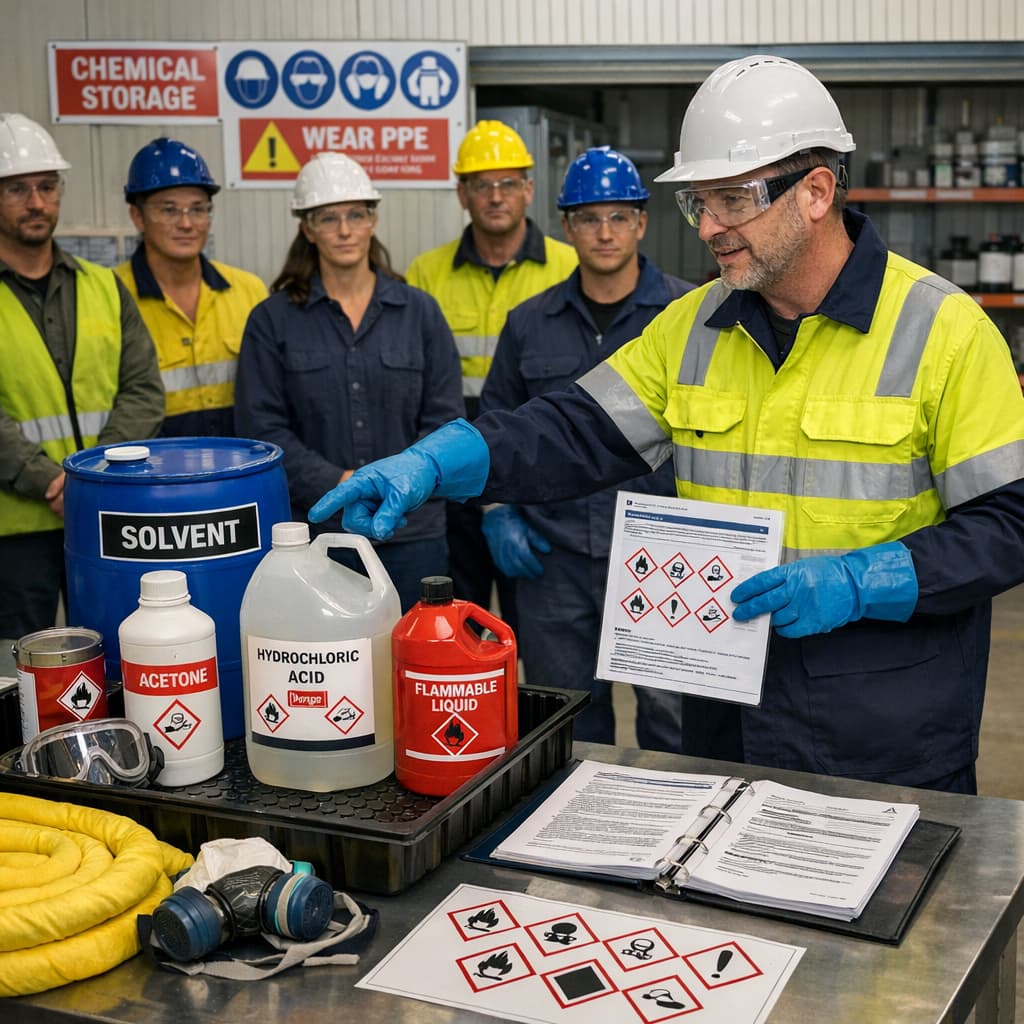
The GHS is the global standard for classifying and labelling chemicals. This course will teach you how to interpret GHS pictograms (hazard symbols), signal words (Danger/Warning), and hazard statements found on chemical labels.
What will I learn about Safety Data Sheets (SDS)?
You will learn the importance of the SDS as the primary source of safety information. The course will focus on how to quickly find and interpret the most critical sections, such as Section 2 (Hazards), Section 8 (PPE), and Section 4 (First Aid).
Will we cover Personal Protective Equipment (PPE)?
Yes. A core practical element is understanding how to correctly select, inspect, and use PPE (e.g., gloves, respirators, eye protection) based on the hazard information found in the SDS to minimize exposure.
Does the course cover emergency response?
Yes. It covers awareness of the different control measures for chemical incidents, including emergency procedures like isolation, ventilation, and the correct steps for initiating a spill response (which complements specific Spill Kit Awareness training).
Is the training tailored to our specific workplace chemicals?
Yes, if delivered on-site. We encourage using your workplace's actual chemical inventory, labels, and SDS examples during the course exercises to ensure the training is immediately relevant to your daily tasks and risks.
How long is the training session?
The Chemical Awareness course typically runs for 3 hours, allowing ample time for GHS/SDS interpretation exercises and PPE demonstrations.
Do we need to supply any equipment?
No. We supply all necessary training aids, including sample SDS, GHS cards, and demonstration PPE.
What should participants wear?
Participants should wear comfortable clothing and their usual work footwear. If the practical component involves a walk-through of a chemical storage area, site-required PPE may be needed.
Is there an assessment?
There is usually a short review or exercise-based assessment to ensure participants can successfully locate critical information on a GHS label and an SDS.
Select Your Learning Format
Choose the delivery mode that best fits your preferences. For non-accredited training, dates are scheduled after you send a quote request.